

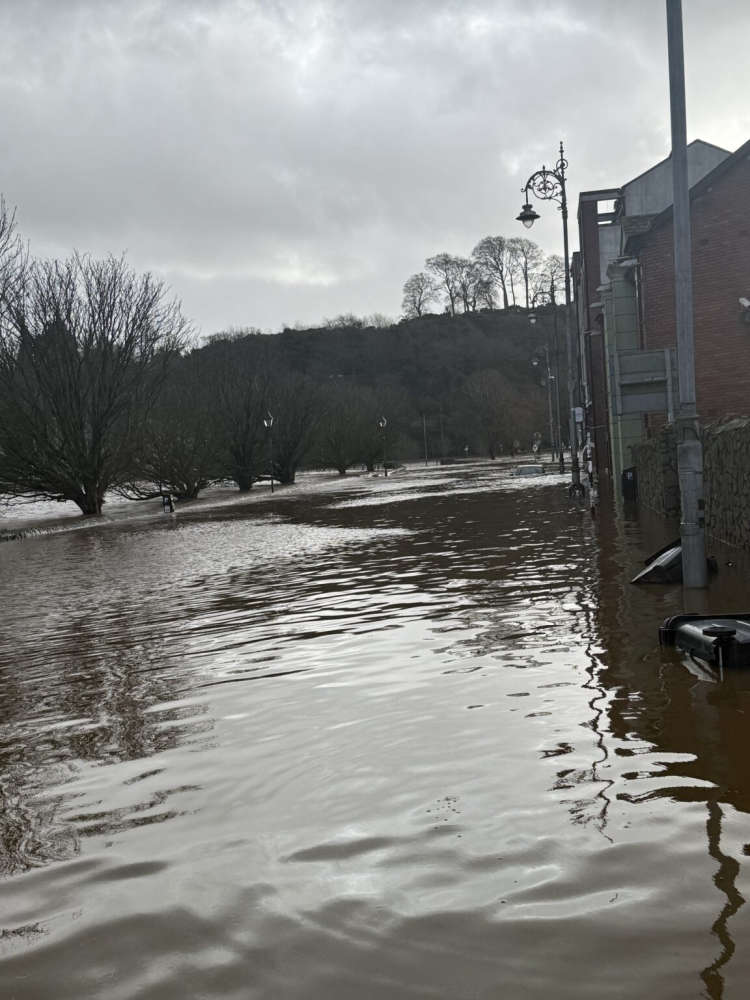
Another Yellow warning for rain will come into effect in County Wexford on Friday morning (30th) at 9am, lasting until midnight. On top of today’s yellow warning for rainfall, and with saturated lands and rivers, this creates a continued high risk for flooding for the Slaney, and particularly Enniscorthy town, right through the bank holiday weekend.
This is an ongoing response situation for Wexford County Council. Their teams remain vigilant, monitoring the river gauges to assess potential impacts in the county, and in particular for the recently flood-affected areas. The Council say they remain ready to respond to the ongoing flooding situation as issues may occur. Repair work is still ongoing around the county, to damaged roads, pipes, and manholes. They continue to engage with business owners and residents in the immediate Slaney catchment in Enniscorthy town.
According to Met Eireann, between 10 and 25mm of rain may fall in the next 24-36 hours. Many rivers, including the Slaney are currently very full, so combined with continued heavy rains and drenched soils, this may create further accumulations of both surface and river water. There has been an accumulated rainfall of 79.6mm between January 22nd and 28th in the county.
The National Emergency Co-ordination Group (NECG) and the Humanitarian Subgroup met again today (Thursday) as the work to alleviate flooding and clean-up in its aftermath continues in areas affected by Storm Chandra.
The NECG will continue to meet and the coordinated response will continue over the bank holiday weekend.The NECG and response agencies will be closely monitoring the situation and preparing for the risk of further flooding over the coming days.
Community Support Hubs remain active today in Enniscorthy and Bunclody to support those affected by the flooding.
The Irish Red Cross Scheme is now open for applications from businesses, social & community premises impacted by flooding and Storm Chandra – details available at https://www.redcross.ie/stormchandra/.
The Emergency Response Payment prevents hardship by providing income-tested financial support to people whose homes are damaged from flooding and severe weather events and who are unable to meet emergency costs for essential needs, household items and structural repair.
The scheme does not provide a general compensation payment for damage or losses incurred as a consequence of a weather event, nor does it cover damage or losses that are insured under home insurance policies or would reasonably be expected to have been covered by an insurance policy. It is available as a support for households which experience unanticipated and exceptional costs in the immediate aftermath of an extreme weather event. The Emergency Response Payment does not cover commercial, agricultural, or business losses.
In administering the Emergency Response Payment and dealing with emergency events, the Department of Social Protection generally adopts a three-stage approach as follows:
- Stage 1 of the scheme is to address hardship in the immediate aftermath of emergency events and provides emergency support payments to cover immediate and essential costs such as the purchase of food, clothing, bedding and essential personal items for immediate use and is not income tested. This support will be available from today until Wednesday, 04/02/2026. It does not cover the purchase of replacement food or other items. – See stage 2.
- Stage 2 involves the replacement of white goods, basic furniture items and other essential household items where there is a valid reason why these were not covered by insurance and where the person can demonstrate that it is essential that the items are replaced and that they do not have the financial resources to cover these costs themselves.
- Stage 3 covers costs of essential structural repairs to a person’s primary residence where the person does not have the resources to cover the costs involved. The type of repairs includes plastering, dry-lining, relaying of floors, electrical re-wiring and painting. These costs are only covered if they are essential, result directly from damage caused by the emergency event and there are valid reasons as to why household insurance was not in place. All costs are subject to expert assessment by a loss adjuster.
The public should note the following national safety advice:
- Weather conditions can change rapidly at the minute, and people should keep up to date with local warnings on Wexford County Council Social Media channels for information on road closures, flooding updates, and community alerts
- Allow for disruption when commuting over the coming days.
- Plan extra travel time and reduce speed.
- Expect surface water, debris, and poor visibility.
- Stay back from riverbanks, streams, and canals – water levels can rise quickly.
- Keep children and pets away from waterways and flooded areas.
- Do not ignore Road Closed signs – when the road ahead is unsafe, the damage may be hidden beneath water, and you may be putting your life at risk.
- Do not drive through floodwater – turn back and use another route.
- Keep away from coastal edges, harbours, piers, and low-lying promenades during high tide.
- The Irish Coast Guard advice remains: “Stay Back, Stay High, Stay Dry.”
- Check in with neighbours, older people or anyone who may need assistance in case conditions worsen.
- Check with Transport Operators when planning journeys
 Ireland Reads 2026 In Wexford Library
 North Wexford TD To Meet With Minister Troy To Discuss Flood Insurance
 Shockwaves Around County Following Untimely Passing Of Popular Priest
 Not enough car spaces in New Ross for above-the-shop apartments



Comments
Add a comment